


Immersion Cooling: Unlocking the Potential of Thermal Management
Energy and thermal sciences are tightly linked. Everything that heats is a transformation of energy — and most of the time, this represents a waste in the form of heat dissipation. A power plant, a thermal engine, a data center, a battery, an electrical transformer, a power electronic device — they all reject huge quantities of heat.
As an example, in electricity generation, the evaluation made by Cullen and Allwood reveals that 72% of the global primary energy consumption is lost after conversion. Thermal management science is therefore recognized as one of the most impactful areas to improve human energy consumption and carbon footprint.
From Air Cooling to Immersion Cooling
Many cooling systems start with air cooling (fans that blow air on a hot surface), then move to indirect water cooling, generally in a cold plate or water jacket. Since the 1960s, a new technology named direct cooling or immersion cooling has been deemed the most advanced cooling technology — often seen as the ultimate cooling solution.
For example, according to a recent paper in Science Direct: “Immersion cooling technology can effectively improve the temperature control level, energy efficiency, stability, and lifespan of electronic devices.”
What is Immersion Cooling?
A thermally conductive fluid is put in direct contact with hot surfaces and goes through a heat exchanger to be cooled again before it circulates back. This process has a heat transfer coefficient 20 to 100 times more efficient than air.
When the hot surface cannot support water-based fluids (like electronic components that could short-circuit), dielectric liquids are used — non-conductive but still excellent for heat transfer.
Adoption Across Industries
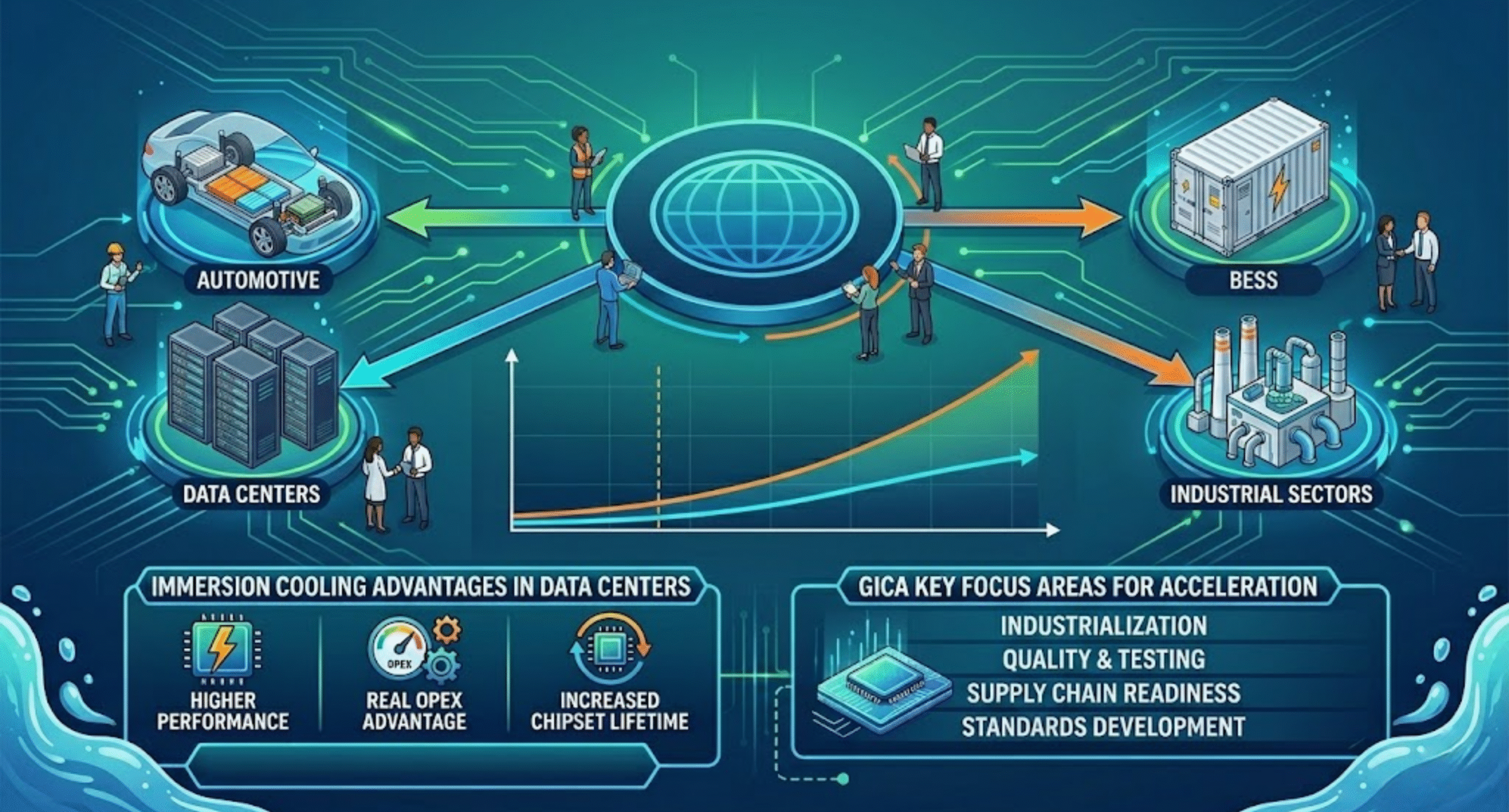
Even though immersion cooling is not yet widely spread in 2025, more and more domains are adopting this technology: including electric transformers, power electronics, data centers, and battery systems for mobility or storage.
The industrial areas where immersion cooling can provide superior efficiency — and therefore save both energy and cost — are huge. Like many innovations, it follows an adoption curve that is not linear, sometimes even dipping before accelerating. We are still in the early adopters phase, but things are moving fast.

Recent Industry Examples
John Deere (the #1 agricultural company globally) acquired Kreisel, a submerged battery expert, in 2023.
Etica AG signed a deal with a Japanese telecom provider to supply 15,000 batteries cooled with immersion cooling for telecommunication antennas.
Intel also validated Shell fluid for its processors in data centers.
Benefits by Sector
In BESS applications, immersion cooling ensures safety by preventing any thermal runaway propagation. In the automotive sector, it enables ultra-fast charging with NMC cells (beyond 4C) while also providing unique safety through the absence of thermal runaway propagation. For data centers, immersion cooling achieves the best PUE in the market—1.02 compared to 1.2 for the best cold plates—along with efficient heat recuperation and the lowest carbon footprint.
Looking Ahead
This relatively new technology still needs standards, development methodologies, education, and promotion. That is why GICA was founded — to push forward the adoption of immersion cooling technology and unlock its full potential.
Sources:
-
ScienceDirect. (n.d.). Primary Energy Consumption – Earth and Planetary Sciences Overview.
-
ScienceDirect. (2015). Estimating the Global Waste Heat Potential. Renewable and Sustainable Energy Reviews.
-
ScienceDirect. (2024). Immersion Liquid Cooling for Electronics: Materials, Systems, Applications and Prospects. Renewable and Sustainable Energy Reviews.
-
Diffusion Research Institute. (2025). Chasm Theory Development: Historical Evolution and Framework.
-
John Deere. (2024). Final Approval of Majority Ownership Acquisition of Kreisel Electric. Corporate announcement.
-
Etica Battery Inc. (2025). Etica Battery to Install 15,000 Fire-Safe UPS Systems for Major Japan Telecom Provider. Press release.
-
Intel Corporation. (2025). Intel and Shell Advance Immersion Cooling in Xeon-Based Data Centers. Newsroom publication.