


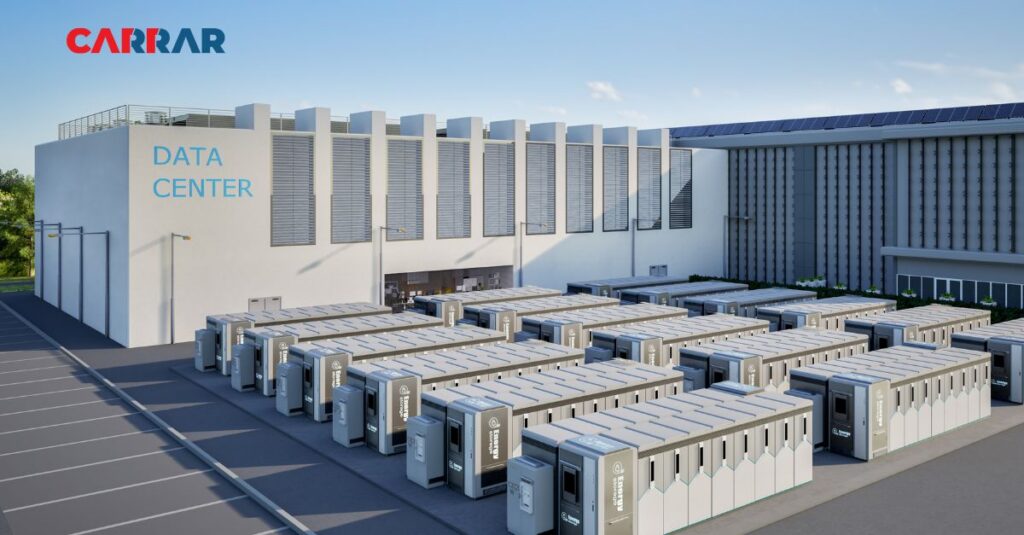
The global Battery Energy Storage Systems (BESS) market is currently experiencing rapid growth as renewable energy deployment accelerates, data centers expand, and grid resilience becomes a strategic priority. According to industry forecasts, the BESS market is expected to nearly double in size from approximately USD 50.8 billion in 2025 to around USD 105.96 billion by 2030 – representing strong compound annual growth of roughly 15.8 % over that period.
But this growth faces a critical bottleneck: Safety.
Regulators are reacting. Standards like NFPA 855 and the push for mandatory Large-Scale Fire Testing (LSFT) are tightening the rules of the game. However, most of the industry is still solving the wrong problem. We are building better fire suppression systems, when we should be building systems that will not catch fire.
Today’s standard BESS safety architecture focusses on detection and suppression: sensors that spot off‑gassing or temperature rises, alerts that notify operators, and extinguishing media that limit the spread of fire once it has begun. But these kinds of responses are reactive: they activate after heat or fire has already begun. At best, these systems contain the fire within a single module; at worst, they fail to stop the cascade, leading to total asset loss; in others, they simply aim to limit the damage.
In a mission-critical grid or data center, “containment” is not enough. The goal must be prevention.
At Carrar, we utilize Two-Phase Immersion Architecture. By immersing battery modules in a dielectric fluid that boils at a specific temperature, we leverage the latent heat of vaporization. This process is passive and self-regulating:
- Uniformity: Every cell is held at a constant temperature, eliminating the hotspots that trigger degradation.
- Propagation Block: The fluid instantly absorbs heat spikes, guaranteeing that propagation is blocked. In most cases, this rapid heat extraction prevents even the single originating cell from entering thermal runaway.
This means safety is not an add‑on measure, but part of the fundamental design of the BESS. It’s an Economic Enabler, the cost of complex suppression systems, insurance premiums, and setback distances are rising. But when you solve the thermal root cause, safety transforms from a cost center into a profitability driver.
Another key strength of Carrar’s approach is that it works with any battery chemistry and type. Because the technology focuses on universal thermal physics rather than chemistry‑specific tricks, it enables system designers to pair the optimal battery chemistry for performance or cost with advanced thermal stability, without forcing trade‑offs between risk and efficiency.
As the BESS market expands- projected to reach more than $100 billion by 2030 – the conversation around safety must evolve alongside growth. Regulatory trends, real‑world fire incidents, and large‑scale testing all underscore a core truth: prevention beats reaction.
Solutions like Carrar’s Two‑Phase Immersion Architecture do more than meet safety standards: they address the root cause of thermal risk, improve system performance, and support the infrastructure needs of renewable energy, grid modernization, and mission‑critical applications such as data centers.
In today’s energy landscape, where storage systems are becoming the backbone of resilient, low‑carbon power networks, integrating robust safe solutions from the outset isn’t just prudent – it’s essential for scaling BESS safely and sustainably.