


“There is no alternative to digital transformation. Visionary companies will carve out new strategic options for themselves, those that don’t adapt will fail.” — Jeff Bezos, Founder, Amazon.
Executive Summary
The global data centre landscape is undergoing a fundamental geographic redistribution. As traditional markets in North America and Europe grapple with power grid constraints, land scarcity, and permitting bottlenecks, a new frontier is emerging in the Gulf Cooperation Council (GCC) region. Fuelled by national digitisation mandates, sovereign AI ambitions, and multi-billion-dollar hyperscaler commitments, the GCC is transforming from a regional catch-up market into a strategic node in the global digital infrastructure network. This article provides a technical deep-dive into the GCC data centre market, the thermal management and cooling challenges unique to arid climates, and the transformative opportunity presented by immersion cooling technologies.
GCC includes Saudi Arabia, United Arab Emirate, Qatar, Kuwait, Bahrain and Oman.
- The GCC Data Centre Market: Scale, Growth, and Strategic Drivers
1.1 Market Size and Forecast
The GCC data centre market was valued at USD 3.48 billion in 2024 and is projected to reach USD 9.49 billion by 2030, growing at a compound annual growth rate (CAGR) of 18.19% during the forecast period. Looking further out, IMARC Group estimates the market was USD 2.39 billion in 2025 (by their methodology) and projects it to reach USD 21.67 billion by 2034, implying a CAGR of 26.78%, one of the fastest-growing regional data centre markets globally.
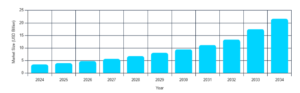
Fig. 1.1: Market Size and Forecast.
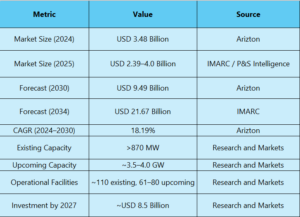
Table 1: GCC Data Centre Market — Key Metrics Snapshot.
1.2 Country-Level Breakdown
The GCC market is not monolithic. The UAE leads with a 35.2% market share in 2025, driven by Dubai’s and Abu Dhabi’s mature colocation ecosystems, sovereign cloud mandates, and operators like Khazna Data Centers and Equinix. Saudi Arabia follows at 28.0% but is the fastest-growing market in the region, with roughly 80% of all upcoming power capacity concentrated in the Kingdom.
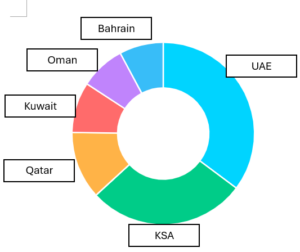
Fig. 1.2: Country-Level Breakdown.
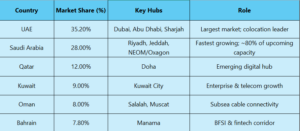
Table 2: GCC Data Centre Market Share by Country (2025).
1.3 Strategic Growth Drivers
Several converging forces are creating a structural demand floor for GCC data centres:
- National Vision Programmes: Saudi Vision 2030, UAE Vision 2031, and Digital Oman 2030 are embedding digital infrastructure into national economic diversification strategies.
- Data Sovereignty Regulations: Saudi Arabia’s PDPL and CST-enforced data localisation rules compel foreign cloud providers to establish in-kingdom facilities. The UAE’s TDRA certifies facilities against tiered reliability standards for government contracts.
- Hyperscaler Commitments: Oracle, Google Cloud, Alibaba Cloud, and AWS have all announced or opened Saudi regions. AWS alone committed USD 5.3 billion for new Saudi data centres. Saudi Arabia’s USD 100 billion Transcendence AI Initiative (backed by PIF) is a marquee programme.
- NEOM Pivot to Digital Infrastructure: NEOM’s strategic review has redirected approximately USD 3 billion from The Line towards Oxagon, where a landmark partnership with DataVolt will deliver a 1.5 GW AI data centre campus (Phase 1 investment: USD 5 billion, operational by 2028). The flagship NEOM Hyperscale Data Centre targets 500 MW, Tier IV, 100% renewable energy, and a PUE of 1.15.
- Geographic Advantage: The GCC sits at the intersection of subsea cable routes connecting Europe, Asia, and Africa (notably the Blue-Raman system), offering low-latency connectivity to three continents.
- Thermal Management and Cooling: The Critical Engineering Challenge
2.1 Why Cooling Defines the GCC Data Centre Equation
In temperate climates, ambient air can assist heat rejection for significant portions of the year. In the GCC, where outdoor temperatures routinely exceed 45°C and coastal humidity is variable, traditional air-side free cooling is largely impractical. This creates a unique thermodynamic challenge:
- Cooling accounts for 60–70% of a GCC data centre’s operational costs, compared to ~40% globally.
- The average PUE in the Middle East is 1.82, significantly worse than the global benchmark of ~1.55 and far from the hyperscale best-in-class of 1.2.
- AI-intensive workloads are pushing rack power densities beyond 50 kW per rack (with designs targeting 100 kW+), far exceeding the ~5–10 kW range that traditional CRAC/CRAH systems were designed for.
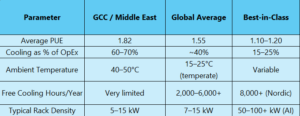
Table 3: Thermal Challenge — GCC vs. Global Data Centre Benchmarks.
2.2 The Cooling Market Opportunity
The Middle East Data Center Thermal Management Market was valued at USD 672.59 million in 2025 and is projected to reach USD 1,856.42 million by 2035, expanding at a CAGR of 10.56%. The broader Middle East & Africa data centre cooling market was valued at approximately USD 1.8–1.85 billion in 2024–2026 and is expected to grow at 14.6–17.9% CAGR through 2033–2036.
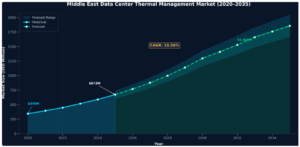
Fig. 2.1: The Cooling Market Opportunity.
Growth is driven by:
- Rising AI workloads and liquid cooling adoption.
- Energy efficiency mandates and ESG compliance.
- Migration from legacy air-only cooling to hybrid and liquid solutions.
- Smart airflow systems and AI-driven thermal optimisation platforms.
2.3 Cooling Technology Landscape
The shift from air-based to liquid-based cooling is not optional in the GCC, it is an engineering necessity. Modern approaches include:
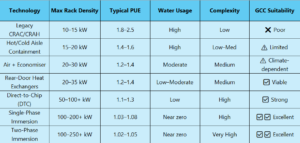
Table 4: Data Centre Cooling Technologies — Technical Comparison.
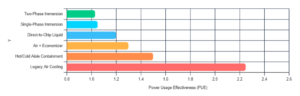
Fig. 2.2: Cooling Technology Landscape.
3. Immersion Cooling: The Transformative Opportunity
3.1 Global Market Overview
The global data centre immersion cooling market was valued at USD 1.7 billion in 2025 and is projected to reach USD 10.9 billion by 2035, growing at a CAGR of 19.8%. This places immersion cooling among the fastest-growing segments within the broader data centre infrastructure ecosystem.
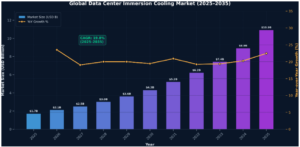
Fig. 3.1: Global Market Overview.
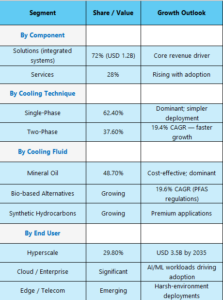
Table 5: Immersion Cooling Market — Segmentation Snapshot (2025).
3.2 Why Immersion Cooling Is Uniquely Suited to the GCC
Immersion cooling is not merely an incremental improvement over air cooling, it represents a paradigm shift in thermal management that addresses nearly every challenge specific to GCC data centre deployments:
- Climate Independence: By submerging IT hardware in dielectric fluid, immersion cooling eliminates dependence on ambient air conditions entirely. PUE values of 1.03–1.08 are achievable regardless of whether the outside temperature is 5°C or 50°C.
- Water Consumption Reduction: Immersion cooling reduces water consumption by 95–98% compared to evaporative cooling towers, eliminating 2–5 million gallons per MW per year. In a water-scarce region where water costs USD 3–8 per 1,000 gallons, this is a strategic advantage.
- Density Enablement: Immersion cooling supports rack densities of 100–200+ kW per rack, enabling up to 5× the computational density of air-cooled systems. This directly supports the AI and HPC workloads that GCC sovereign cloud and Transcendence AI initiatives demand.
- Noise Reduction: Elimination of server fans reduces acoustic output substantially critical for edge deployments in urban, mixed-use environments common in GCC smart city projects.
- Renewable Energy Synergy: The GCC’s abundant solar and wind resources pair well with immersion cooling’s lower energy footprint. NEOM’s data centre targets 100% renewable energy with a PUE of 1.15 using closed-loop liquid cooling.
3.3 The Supply Chain Opportunity
The immersion cooling ecosystem extends well beyond the immersion tanks themselves. It creates demand for a range of thermal management system (TMS) components:
- Coolant Distribution Units (CDUs): Regulate coolant flow and temperature; the global CDU market is projected to expand at a 17% CAGR through 2028.
- Liquid Cooling Pumps: High-capacity pumps (>250 W) dominate, with a market value expected to reach USD 3,053 million by 2035 at a 23.8% CAGR.
- Specialised Hoses and Fluid Conveyance: EPDM-based, zinc-free, flame-resistant hoses (such as the Gates Data Master™ family) are purpose-designed for data centre liquid cooling loops.
- Heat Exchangers, Manifolds, and Sensors: Precision thermal control components for both facility-level and rack-level cooling architectures.
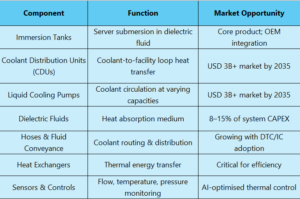
Table 6: Immersion Cooling — Key Supply Chain Components and Opportunity.
3.4 Industry Collaboration: The GICA Model
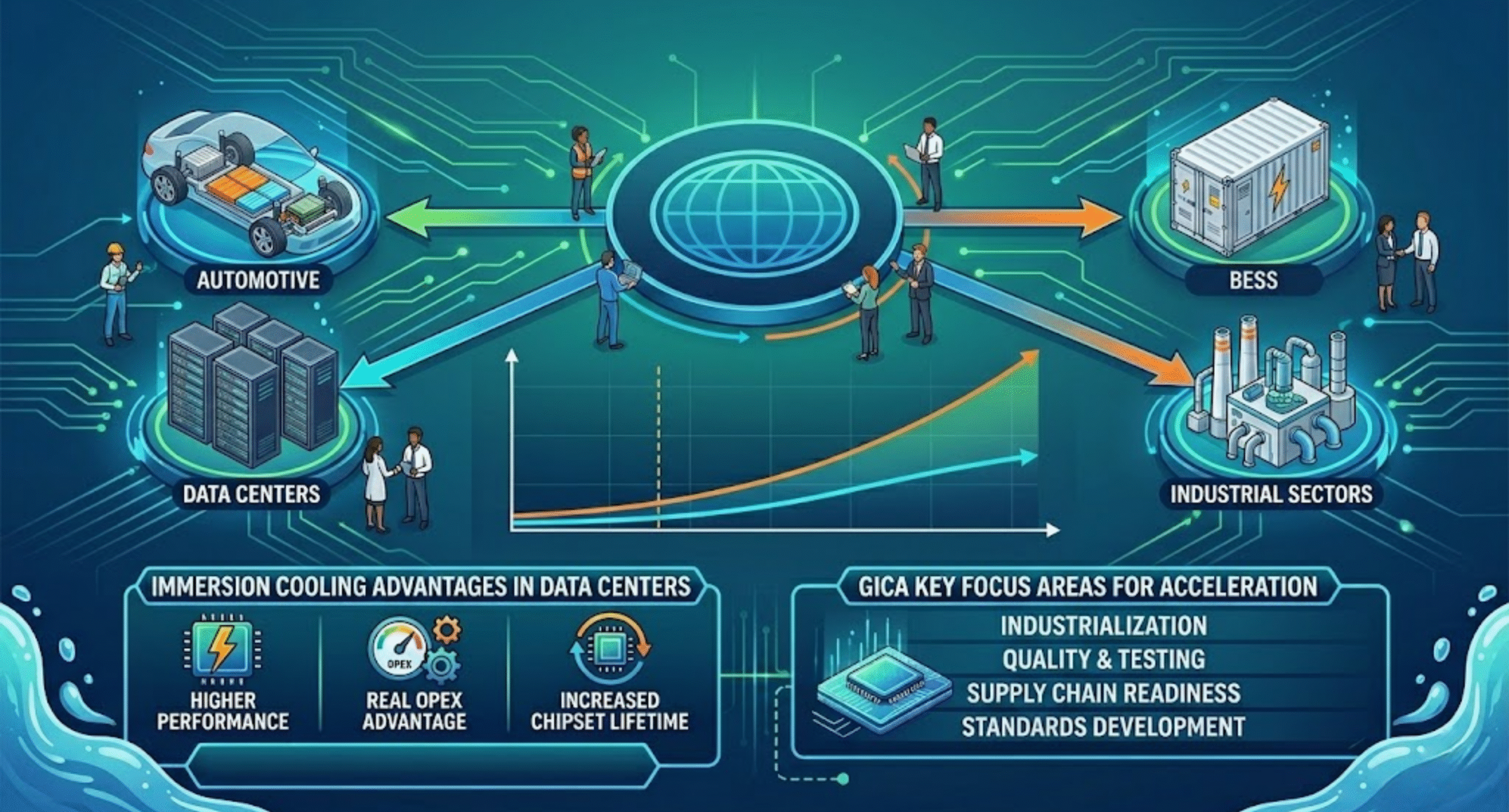
The Global Immersion Cooling Association (GICA), founded by industry innovators is working to accelerate immersion cooling adoption across both high-performance computing and e-mobility industries. GICA’s initiatives include standards development, industry education through webinars and whitepapers, and global networking connecting OEMs, supply chains, and regulatory bodies
- Strategic Implications and the Path Forward
4.1 Investment Thesis
The convergence of GCC data centre growth, extreme-climate thermal challenges, and AI-driven density escalation creates a compelling investment thesis for immersion cooling and advanced thermal management:
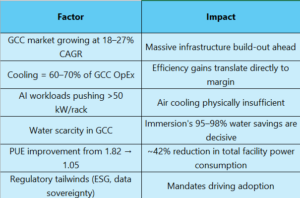
Table 7: Investment Thesis.
4.2 Key Risks and Challenges
- Capital intensity: Immersion cooling CAPEX remains 2–3× higher than raised-floor air architectures, with TCO breakeven typically above 50 kW/rack densities.
- Integration complexity: Retrofitting existing facilities requires significant engineering; “immersion-born” greenfield designs are preferable.
- Fluid management: Chemical compatibility, contamination prevention, and coolant lifecycle management (5–8 year fluid lifetimes) add operational considerations.
- Standardisation gaps: Lack of universal pump interfaces, CDU designs, and fluid specifications complicates multi-vendor deployments, though GICA and industry bodies are working to address this.
- Conclusion
The GCC data centre market represents one of the most dynamic and strategically significant growth corridors in global digital infrastructure. With USD 9.5–21.7 billion in projected market value by 2030–2034, 4 GW of upcoming capacity, and sovereign AI ambitions backed by hundreds of billions in state investment, the region is transitioning from a peripheral market to a critical global hub.
However, the extreme thermal environment of the Gulf temperatures exceeding 45°C, water scarcity, and PUEs averaging 1.82 means that cooling is not merely an operational consideration but the defining engineering constraint of GCC data centre viability. Immersion cooling, with its climate-independent PUE of 1.03–1.08, near-zero water consumption, and support for AI-grade rack densities, is uniquely positioned as the enabling technology for this market.
For infrastructure providers, component manufacturers, and thermal management specialists, the GCC immersion cooling opportunity is not a future prospect, it is a present imperative.
References
Arizton Advisory & Intelligence. (2025, March). GCC data center market – Investment analysis & growth opportunities 2025–2030 (4th ed.). Arizton. https://www.arizton.com/market-reports/gcc-data-center-market-investment-analysis-report.
Arizton Advisory & Intelligence. (2025, March). GCC – Analysis of 99 data center facilities and 35 data center operators. Industry Today. https://industrytoday.co.uk/it/gcc-analysis-of-99-data-center-facilities-and-35-data-center-operators-arizton.
IMARC Group. (2026). GCC data center market: Size, share, trends and forecast by application, type, component, size, and region, 2026–2034. IMARC. https://www.imarcgroup.com/gcc-data-center-market.
Mordor Intelligence. (2026). Saudi Arabia data center market size & share analysis – Growth trends and forecast (2026–2031). Mordor Intelligence. https://www.mordorintelligence.com/industry-reports/saudi-arabia-data-center-market.
S&P Global Market Intelligence. (2025, December 2). The Saudi Arabia data center market: A catalyst for economic innovation. S&P Global – Look Forward: Data Center Frontiers. https://www.spglobal.com/en/research-insights/special-reports/look-forward/data-center-frontiers/saudi-arabia-data-center-market.
PwC Middle East. (2025, April 10). Unlocking the data centre opportunity in the Middle East. PwC. https://www.pwc.com/m1/en/media-centre/articles/unlocking-the-data-centre-opportunity-in-the-middle-east.html.
Data Insights Market. (2026, May 22). Saudi Arabia data center market: $2.08B (2025), 19.84% CAGR – Forecast 2026–2034. https://www.datainsightsmarket.com/reports/saudi-arabia-data-center-market-10844.
MarkNtel Advisors. (2024, December). Saudi Arabia data center market research report: Forecast (2025–2030). https://www.marknteladvisors.com/research-library/saudi-arabia-data-center-market.html.
Alharthi, A. (2025, February 24). Saudi Arabia data center industry report 2025: Growth, investments & workforce trends. TASC Outsourcing. https://tascoutsourcing.sa/en/insights/reports/Saudi-Data-center-Industry.
NEOM. (2025, February 10). DataVolt signs agreement with NEOM to design and develop the region’s first truly sustainable, net-zero AI factory campus in Oxagon [Press release]. https://www.neom.com/en-us/newsroom/datavolt-signs-agreement-with-neom.
Swinhoe, D. (2025, February 11). DataVolt plans 1.5GW data center campus in Neom’s Oxagon. DatacenterDynamics. https://www.datacenterdynamics.com/en/news/datavolt-plans-15gw-data-center-campus-in-neoms-oxagon/.
GREY Journal. (2026, May 23). NEOM halts The Line until 2030, pivots to AI data centers. GREY Journal. https://greyjournal.net/news/neom-the-line-halted-2030-oxagon-ai-data-centers/.
Saudi Press Agency. (2025, February 10). NEOM, DataVolt launch sustainable AI project in Oxagon with $5 billion investment. SPA. https://www.spa.gov.sa/en/N2259124.
Weller, C. (2025). DataVolt and NEOM to develop net zero AI campus in Oxagon. Data Centre & Network News. https://dcnnmagazine.com/data-centres/datavolt-and-neom-to-develop-net-zero-ai-campus-in-oxagon/.
DC Market Insights. (2025). Middle East data center thermal management market: Growth, share, opportunities & competitive analysis, 2025–2035 (Report ID: 11158). https://www.dcmarketinsights.com/report/middle-east-data-center-thermal-management-market.
WiseGuy Reports. (2026, April). Global data center thermal management market research report: Market size, 2025–2035. https://www.wiseguyreports.com/reports/data-center-thermal-management-market.
IDTechEx. (2025). Thermal management for data centers 2025–2035: Technologies, markets, and opportunities. IDTechEx. https://www.idtechex.com/en/research-report/thermal-management-for-data-centers/1036.
Ken Research. (2025, December). Middle East data center cooling market report: Size, share, growth drivers, trends, opportunities & forecast 2025–2030. https://www.marketresearch.com/Ken-Research-v3771/Middle-East-Data-Center-Cooling-44109722/.
Data Insights Market. (2026, May). Middle-East data center cooling market: 16.8% CAGR outlook 2034 – Forecast 2026–2034. https://www.datainsightsmarket.com/reports/middle-east-data-center-cooling-market-14447.
Global Market Insights Inc. (2026, January). Data center liquid cooling market size & share report, 2026–2035. https://www.gminsights.com/industry-analysis/data-center-liquid-cooling-market.
Emergen Research. (2026, June). Data center liquid cooling market (2025–2035): By cooling technology, by coolant type, by data center type, by end-use industry, by region. https://www.emergenresearch.com/industry-report/data-center-liquid-cooling-market.
Market Research Future. (2026, April). Data center liquid cooling market report: Size, share 2035 (Report ID: MRFR/ICT/23218-HCR). https://www.marketresearchfuture.com/reports/data-center-liquid-cooling-market-24844.
Astute Analytica. (2026, June). Data center liquid cooling market: Global industry analysis 2015–2024 and opportunity assessment 2025–2035. https://www.astuteanalytica.com/industry-report/data-center-liquid-cooling-market.
Future Market Insights. (2025, September). Data center liquid cooling market: Global industry analysis report – 2035. https://www.futuremarketinsights.com/reports/data-center-liquid-cooling-market.
Expert Market Research. (2026, April). Immersion cooling market size, share and forecast trends – Growth analysis and outlook report (2026–2035) (Report ID: EMR3404). https://www.expertmarketresearch.com/reports/immersion-cooling-market.
Reports and Data. (2025, December; modified 2026, June). Immersion cooling market: Size, share, trends, demand, and forecast, 2025–2035. https://www.reportsanddata.com/report-detail/immersion-cooling-market.
Market Growth Reports. (2025, December). Immersion cooling market size, trend | Forecast report [2035] (Report ID: MGR103825). https://www.marketgrowthreports.com/market-reports/immersion-cooling-market-103825.
Core Market Research. (2025). Immersion cooling market size, trends & forecast 2025–2035. https://coremarketresearch.com/report/immersion-cooling.
Research Nester. (2025, September). Immersion cooling market size, share & growth report 2035 (Report ID: 4896). https://www.researchnester.com/reports/immersion-cooling-market/4896.
Econ Market Research. (2026, June). Immersion cooling market size, share, trends, growth, and industry analysis – Regional analysis and forecast period 2026–2035 (Report ID: EMR001537). https://www.econmarketresearch.com/industry-report/immersion-cooling-market.
International Energy Agency. (2024). Electricity 2024: Analysis and forecast to 2026. IEA. https://www.iea.org/reports/electricity-2024.
U.S. Department of Energy. (2024). 2024 United States data center energy usage report. Lawrence Berkeley National Laboratory.